
How Long Luxury Homes Really Take to Build, and What Causes Delays
We hear it often. A family in Wellesley finishes their custom home and says their biggest regret wasn’t anything about the home itself. It was the extra months they lost waiting for it to be finished.
Their builder gave them a timeline that sounded reasonable at the start. But as the project moved forward, decisions dragged, coordination broke down, and what should have been a structured process became unpredictable. By the time they moved in, their kids were already in a different stage of life.
That experience is more common than most people expect, especially in high-end residential construction. If you are planning a custom home or full transformation, understanding what actually drives timelines is one of the most important decisions you can make.
What a Realistic Timeline Looks Like for a Luxury Home
Many clients are told what they want to hear early on. Short timelines sound appealing, especially when you are eager to get your family into the home you have been envisioning.
But a true luxury build, done properly, follows a more structured path.
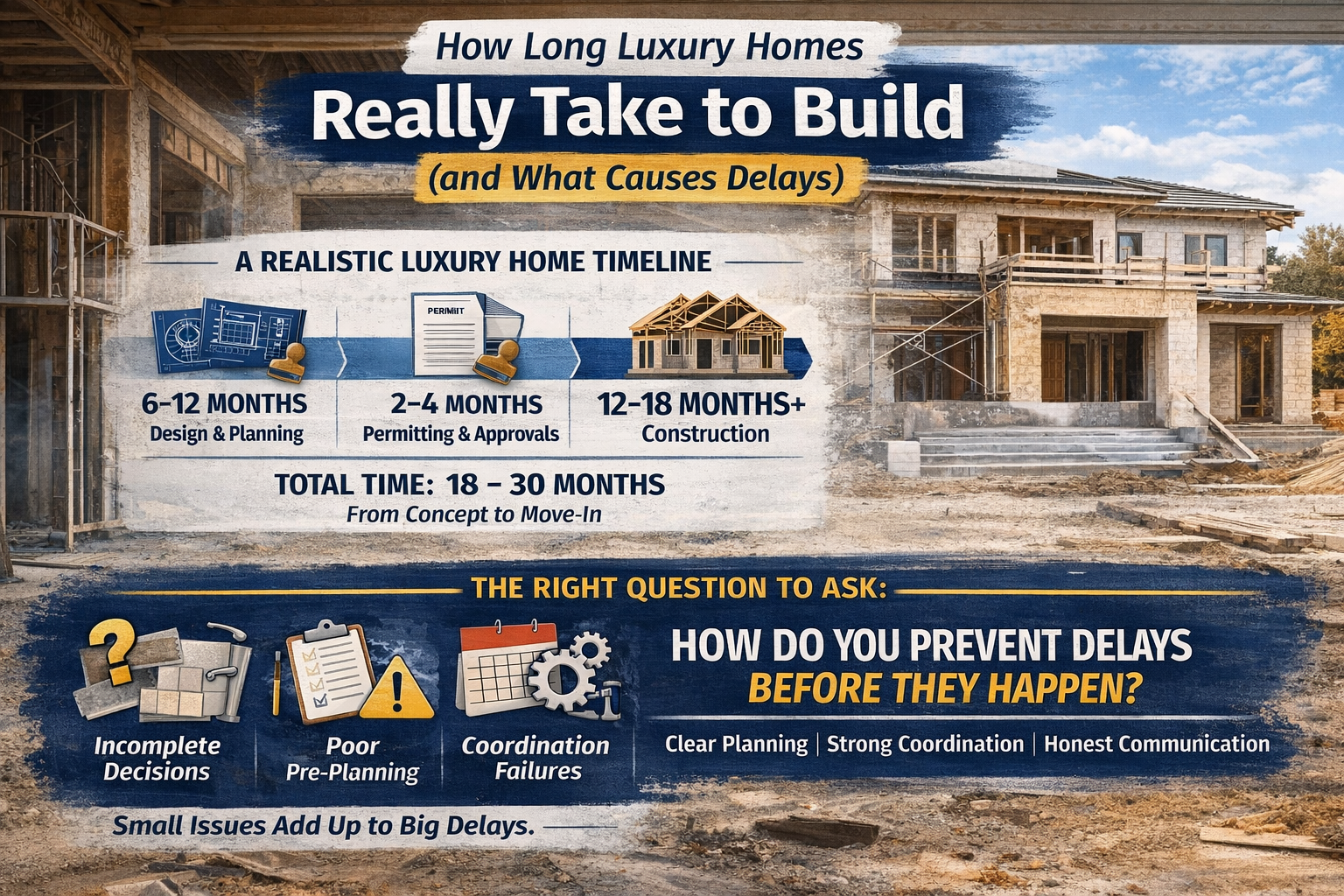
For a $3.5M to $7.5M custom home in Wellesley and surrounding towns, a realistic timeline typically looks like this:
Design and pre-construction: 6 to 12 months
Permitting and approvals: 2 to 4 months, sometimes overlapping
Construction: 12 to 18 months or more, depending on complexity
Most projects fall into a total range of 18 to 30 months from initial concept to move-in.
That may feel longer than expected. But the key point most homeowners miss is this:
The goal is not just to finish quickly. The goal is to finish predictably, without costly setbacks, and at the level of quality you expect.
When timelines are compressed artificially, something gives. It is usually coordination, quality, or cost control.
Why Luxury Projects Take Longer Than Expected
It is easy to assume that a larger budget should make things move faster. More resources, more capability, fewer constraints.
In reality, the opposite is true.
As the level of detail increases, so does the complexity behind the scenes.
A high-end home is not just larger. It involves custom millwork, specialized materials with longer lead times, detailed coordination across multiple teams, and a much higher standard of precision.
A simple cabinet package can be ordered and installed quickly. A fully custom kitchen with integrated appliances, specialty finishes, and tailored storage requires multiple rounds of design, approvals, fabrication, and coordination.
Multiply that across the entire home, including mechanical systems, outdoor spaces, and specialty features, and it becomes clear why timelines expand.
Longer timelines are not the problem.
Uncontrolled timelines are.
The Real Causes of Delays
When projects run late, it is rarely due to one major issue. It is usually a series of smaller breakdowns that compound over time.
Incomplete Decisions Early in the Process
One of the most common sources of delay is starting construction before key selections are finalized.
It may feel efficient to make decisions as you go, but in a luxury build, that approach creates constant interruptions.
When cabinetry, tile, fixtures, or layouts are still evolving mid-construction, trades cannot move forward cleanly. Work pauses, schedules shift, and momentum is lost.
And here is the part many clients do not realize:
Losing a month in the middle of a project is no different than losing a month at the end. The schedule does not recover on its own.
Every delay pushes everything behind it.
Poor Pre-Construction Planning
A well-run project is largely determined before construction begins.
There is a principle in large-scale project management often summarized as “plan slow, act fast.” When planning is rushed, execution becomes inefficient and unpredictable.
If budgets, scopes, and specifications are not clearly defined upfront, issues surface during construction when they are harder and more expensive to resolve.
Strong pre-construction planning aligns expectations, reduces uncertainty, and creates a clear path forward for everyone involved.
Lack of Coordination Between Teams
Luxury homes involve a large group of people. Architects, designers, engineers, trades, and suppliers all play a role.
If those teams are not tightly coordinated, even small miscommunications can create delays.
A missing detail in a drawing, a late material order, or a scheduling conflict between trades can ripple through the entire project.
This is where process becomes critical.
Over time, we have built a detailed scheduling system that maps out each phase of construction in advance, with clear sequencing and dependencies between trades. We manage that schedule through JobTread, which allows our team and our clients to see progress, track decisions, and stay aligned in real time.
This level of visibility and structure does not eliminate complexity, but it prevents that complexity from turning into confusion or delay.
Material Lead Times and Supply Chain Realities
High-end homes often include imported materials, custom fabrication, and specialty items that are not readily available.
These items can have lead times of several months.
If they are not identified and ordered early, they can stall progress later in the build.
A well-managed project anticipates these timelines and integrates them into the schedule from the beginning.
Overpromising at the Start
Some builders present aggressive timelines to win the project. It feels reassuring in the moment, but it creates unrealistic expectations.
As the project unfolds, reality takes over. Delays begin to appear, and trust starts to erode.
A realistic timeline may feel more conservative at the outset, but it leads to a far better experience throughout the project.
The Client’s Role in Keeping the Project on Track
There is one part of the timeline that is often overlooked, and it is just as important as planning and construction.
The client’s decision-making process.
The projects that move most efficiently are not just well managed. They are supported by clients who are engaged, prepared, and willing to make timely decisions.
That does not mean rushing decisions. It means making them within a structured timeline, with the right information in front of you.
When decisions are delayed or revisited repeatedly, the schedule cannot hold. Trades are rescheduled, materials are delayed, and the entire sequence begins to shift.
The most successful projects are true partnerships. Builder and client working together, each doing their part to maintain momentum.
What a Well-Managed Timeline Feels Like
When a project is planned and managed properly, the experience feels very different.
Decisions happen in a logical sequence.
Materials arrive when they are needed.
Trades move through the home without interruption.
Communication is consistent and clear.
Instead of reacting to problems, the process feels controlled and predictable.
That does not mean there are no challenges. Every custom home has them.
But they are addressed early, with context, and without derailing the entire schedule.
For families building in this price range, that sense of control matters. It allows you to stay focused on the outcome, not the stress.
The Real Question to Ask Your Builder
If timeline matters to you, and for most families it does, the question is not:
“How fast can you build this?”
It is:
“How do you prevent delays before they happen?”
That question reveals how a builder plans, coordinates, communicates, and protects your time.
Because in the end, time is the one thing you cannot get back.
Building With Clarity and Confidence
A luxury home should enhance your family’s life, not put it on hold longer than necessary.
The difference comes down to how the project is structured from the beginning and how it is managed every day after that.
When timelines are approached with honesty, planning, and attention to detail, the process becomes far more predictable and far more enjoyable.
And that is what most families are really looking for.
Not just a finished home, but a building experience that feels as considered as the home itself.
Build With Us
If you are planning a custom home or whole-home renovation/addition transformation in Wellesley or the surrounding area, and you want a clear, well-managed path from concept to completion, we would be glad to help.
Build with us, and enjoy the process as much as the result!